East Sussex County Council is borrowing £70 million to stay afloat. The figure in the title – £211 million is the council’s total external debt as reported by an independent BBC Shared Data Unit analysis of public accounts; the council’s own Q3 Treasury Management report for 2025/26 puts the figure at £200 million. Either way, the emergency £70 million approved this year is not the debt: it is the latest addition to it. The Conservative-run council has been in charge locally and nationally for most of the past decade and a half. And there has been no clear public apology accepting responsibility for the situation residents now face.
Let us start with the number that should stop every East Sussex resident in their tracks: three quarters. Adult social care and children’s services are forecast to consume around 74 per cent of East Sussex County Council’s usable budget by 2028/29. Roads, libraries, waste collection, trading standards, support for businesses: everything else the council does for half a million people must be funded from what is left. And what is left is shrinking every single year.
The scale of the collapse is not in dispute. According to the council’s own budget reporting – set out in the councillor report circulated to Rother-area Parish Councils in February 2026 – Adult Social Care costs have increased by 40 per cent since 2022/23, and Children’s Services by 54 per cent over the same period. These are East Sussex figures, not national ones, though they are consistent with the national picture: the National Audit Office found that local authority spending on children’s residential care rose 54 per cent nationally between 2019/20 and 2023/24.
In February 2026, the council agreed a budget that can only be balanced by borrowing £70 million from central government through what is known as a capitalisation direction. Without that emergency support, council tax would have needed to rise by around 19 per cent in a single year. Instead it will rise by just under five per cent – the legal maximum – and even that is not enough.
That £70 million is not free money. It is government permission to treat day-to-day spending as capital expenditure, funded by borrowing. At current government lending rates of around four to five per cent, the council is looking at roughly £3 to £3.5 million a year in interest charges alone, before a single penny of the loan is repaid. That is £3 million that cannot be spent on roads, libraries or social care. It is money borrowed today that will squeeze future budgets for years to come.
But the £70 million emergency borrowing is only part of the story. According to the council’s own Treasury Management reports, ESCC’s actual external debt currently stands at around £200 million – money already borrowed and owed to lenders, principally the Public Works Loan Board. Its true underlying borrowing need, measured by what is known as the Capital Financing Requirement, exceeded £292 million at the start of 2025/26 and is forecast to reach over £313 million by the end of it. There is a gap of over £113 million between what the council has actually borrowed and what it has already committed to spend – a hidden liability it is plugging with shrinking reserves rather than formal borrowing. Official council forecasts project that the Capital Financing Requirement could peak at around £478 million by 2035/36, with external borrowing potentially reaching £647 million by 2034/35. The council’s own strategy acknowledges it may need to borrow to finance day-to-day activity as soon as 2028/29.
The leader of Eastbourne Borough Council described this kind of borrowing as extending your mortgage to cover day-to-day living costs, and concluded it was not sustainable financial management. He was right. Borrowing to fund running costs is the last resort of an organisation that has run out of options, not a sign of a council in control of its finances.
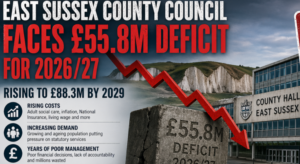
Meanwhile, the council’s reserves have collapsed. Total reserves fell from £88.6 million to a forecast £60.1 million within a single year, and cash investment balances fell by around 50 per cent in twelve months. The council’s chief finance officer has described reserves as being at the absolute minimum level required to safeguard against unforeseen risks. The budget gap stands at £55.5 million this year, rising to £83.6 million by 2027/28.
The council’s own warnings are stark: without a significant and sustained increase in government funding, it faces an increasingly unsustainable financial position in the years ahead. For a council that has made nearly £160 million of savings since 2010, this is not a story about reckless spending. It is a story about a system that was heading for collapse for years, and nobody with the power to stop it chose to act.
Every Conservative Councillor and Conservative MP Knew. They Just Didn’t Fix It.
The demographic reality of East Sussex has never been a secret. This county has one of the oldest populations in England. Older residents drive demand for adult social care. The costs were always going to rise. Anyone looking at the numbers ten years ago could see where this was heading, and many people did. They said so, loudly, in reports, in council chambers, and in representations to government.
In 2011, economist Andrew Dilnot handed the Conservative government a detailed, fully costed plan to reform social care funding. It was shelved. David Cameron’s government sat on it. Theresa May’s government promised action and delivered none. Boris Johnson stood on the steps of Downing Street in 2019 and promised to “fix social care once and for all.” He did not. A health and social care levy was introduced in 2022 and reversed within months.
Fourteen years. Numerous prime ministers. Zero structural reform.
For much of this period, East Sussex County Council, itself Conservative-led, had a direct line to sympathetic ears in Westminster. The political alignment between local and national government was as favourable as it could ever be. If there was a moment to demand reform, to use that relationship to force the issue, that was it. The opportunity came and went, repeatedly, and the crisis that local councillors now blame on central government is one they never fought hard enough to prevent.
Who Is Actually Pocketing the Money?
It is worth asking not just why costs have risen, but where the money is actually going. A significant portion of East Sussex’s social care budget flows directly to private companies, care home operators, agency staffing firms and, most expensively of all, private providers of residential placements for vulnerable children. These are businesses whose purpose is to generate profit, and in the absence of sufficient public infrastructure, councils like East Sussex have no choice but to pay whatever the market demands.
The situation with children’s services is particularly hard for the Conservatives to justify. Rather than investing in dedicated facilities where vulnerable young people can receive the intensive, round-the-clock support they need under one roof, the county is instead funding 24-hour care delivered in situ, across multiple dispersed locations, each requiring its own staffing, management and overhead. It is, by any measure, the most expensive way to deliver care.
A strategic decision to build or commission a single, properly staffed facility for children with the highest needs would almost certainly cost less in the long run. But that requires upfront capital investment and long-term political planning, precisely the kind of thinking that has been in short supply. The result is a council that has become, in effect, a captive customer, unable to negotiate, unable to build alternatives, and watching public money flow out of the county into the hands of private operators while the people who actually need care receive a fragmented service. This was not inevitable. It was a choice, or more accurately, the consequence of repeatedly choosing not to choose.
The Blame Game Voters Have Heard Before
Now comes the part that many residents will find hardest to stomach. As local Conservative councillors seek re-election in May, the message from the doorstep is already taking shape: it was Westminster’s fault. The funding formula was unfair. The government changed the rules. We did our best with what we were given.
On the specific question of the funding formula, it is important to be fair – and being fair here implicates both the Conservatives and the Labour Party. The losses to East Sussex from Labour’s new funding formula run to at least £12.6 million as a direct result of formula changes, and council leader Keith Glazier has stated publicly that when the full effects of the settlement are included, the county is worse off by around £18 million in total. The mechanics of that loss are set out in detail in the council’s own budget reporting. The new formula removes rurality as a factor from almost all funding formulae. It contains no metric that reflects the significant proportion of East Sussex residents aged over 85. It uses median wages as a proxy for the labour costs the council actually bears, which understates true cost pressures. And it is compounded by the continuation of the Recovery Grant, which top-slices the overall funding pot before distribution, directing money to qualifying authorities before the formula is even applied. The cumulative effect is a funding model that fails to capture the true cost of delivering statutory services in a county with high social care demand and a dispersed, rural population.
But before local Conservatives take too much comfort in that, they should answer this: the Fair Funding Review – which promised to reform the very formula they now complain about – was announced by the Conservative government in 2016, delayed, delayed again, and finally abandoned by the Truss government in 2022. Labour inherited a broken formula that Conservatives had repeatedly promised to fix and never did. Both parties have treated the funding of East Sussex as an afterthought – the Conservatives through inaction, Labour through a reform that fails to account for rural and ageing county demographics.
What is notably absent from any of the statements coming out of County Hall is the simplest and most powerful thing a politician can say. There has been no clear public apology accepting responsibility for the situation residents now face – no acknowledgement that things went wrong on their watch, that decisions made or deferred over fourteen years have brought the county to this point. Voters are often more forgiving than politicians assume. What they find much harder to stomach is the careful language that accepts no responsibility, distributes blame elsewhere, and asks for another chance without ever saying what would be done differently.
There is a particular kind of institutional fatigue that sets in when the same people have managed the same problems for too long – not corruption, not incompetence, but a slow loss of energy and imagination that makes transformative thinking almost impossible. When the response to a 54 per cent rise in children’s services costs is to borrow money and make modest savings rather than to fundamentally rethink how those services are commissioned and delivered, it is reasonable to ask whether the people in charge still have the appetite to do what is actually needed. Fresh eyes and fresh thinking are not a guarantee of better outcomes. But exhausted ones rarely produce them.
The Conservative Administration Supported Cancelling This Election
Start here, because this fact alone could make your blood run a little hot. The Conservative-led administration that has run East Sussex County Council for decades actively supported postponing this election – not once, but twice. When the Labour government offered councils the option to delay their scheduled elections, East Sussex’s Conservative leadership chose to request postponement.
This election is taking place because Reform UK launched a High Court challenge to that postponement. The government reversed its position on Monday 16 February 2026 – three days before the case was due to be heard – following the legal challenge and advice that the government was likely to lose. An administration confident in its record does not seek to delay the moment when voters get to assess it.
The Council Elected on 7th May Is Proposed to Be the Last
Here is the fact that transforms this election from the routine to the momentous. Subject to government approval, the council elected next month is expected to be the last East Sussex County Council. Under the government’s proposed devolution plans, the county council and all five district and borough councils – Rother, Hastings, Eastbourne, Lewes and Wealden – are to be merged into a single unitary authority for the whole of East Sussex, covering around 550,000 people. If approved, the new body is expected to be formally operating by April 2028. The government officially launched its consultation on this in late 2025, and responses closed in January 2026.
This is not a minor administrative reshuffle. It would be the most significant restructuring of local government in East Sussex since the 1970s. The council you elect on 7th May would negotiate the terms of that merger with the district councils. It would decide how services are combined or cut, how staff are transferred, and how the combined debts of all six councils are accounted for and allocated.
On that last point, the numbers are stark. The six councils entering this proposed merger carry combined debts exceeding £597 million. ESCC alone accounts for around £211 million of that total, while Eastbourne Borough Council carries a further £183 million. The incoming unitary authority would inherit this liability in full. The council elected on 7th May will determine how that debt is managed, restructured and serviced for a generation.
Residents deserve to know that whoever they vote for is ready to confront that reality – not paper over it.
At the same time, a new Mayoral Combined County Authority for Sussex – bringing together East Sussex, West Sussex and Brighton and Hove – is expected to be established, with devolved powers over transport, housing, investment and economic growth. If confirmed, the council elected on 7th May will be East Sussex’s voice at that table. Who sits in County Hall will determine how loudly and how effectively Bexhill, Battle and the surrounding communities are heard in those discussions.
What the Numbers Tell Us
In 2021, turnout in the county council divisions covering this constituency ranged from a dismal 31.67 per cent in Bexhill East to 44.14 per cent in Bexhill West. More than six in every ten registered voters in this area did not cast a ballot. In Battle and Crowhurst, where the Conservative candidate was beaten by the Liberal Democrats – a result that would have seemed unthinkable a decade ago – the margin was decided by a few hundred votes from an electorate of over 7,600.
That is democracy working on the thinnest of mandates. The people who didn’t vote didn’t abstain from a low-stakes ritual. They handed enormous power to a small minority of their neighbours. Given what this next council will decide, doing so again would be a more consequential act of disengagement than at any point in recent memory.
Think Carefully Before Voting Independent
Local democracy in our constituency has always thrown up independent candidates, and in normal times there is something genuinely appealing about the idea – a local figure, beholden to no party whip, answering only to their community. In a planning dispute or a highways argument, an independent voice can be effective.
These are not normal times, and a county council election is not a district or town council election. The task facing councillors elected on 7th May is to negotiate, bloc by bloc and meeting by meeting, the most complex institutional restructuring this county has seen in fifty years – if the reorganisation proceeds as proposed. It requires councillors who can form a governing majority, hold a policy position across months of technical negotiation, and leverage their group’s votes to win concessions on how the unitary authority is structured, what it prioritises, and how its inherited debts are handled.
An independent councillor, however well-intentioned, arrives in the chamber without a caucus, without leverage, and without the ability to make or break a majority. Being independent in a chamber that may be deciding the future shape of East Sussex is not a principled stance. It is a structural limitation that benefits nobody the independent claims to represent.
As for the wider field: Reform UK holds two seats on the current council – Sam Adeniji in Seaford North and Aidan Fisher in Hastings – and the Hastings result in particular should concentrate minds. Fisher won the Ashdown and Conquest by-election in November 2025 with 32 per cent of the vote on a 31 per cent turnout. The Greens came second. The Conservatives came third. Labour, despite holding the parliamentary seat, came fourth. 7th May is likely to produce similar dynamics in multiple divisions across the county, and voters should weigh that carefully when they look at their own ballot paper.
Do You Want More of the Same?
The Conservative administration that sought to postpone this election has had decades of uninterrupted control to shape how East Sussex looks and works. If you are satisfied with the result, they deserve your vote. If you are not, it is worth asking whether 7th May is finally the moment to vote for someone else.
Start with the roads. East Sussex Highways has paid out more than £639,000 in compensation to drivers for pothole damage over the last five years, according to a Freedom of Information request reported by the Sussex Express in May 2025. Last year the council repaired over 20,000 individual potholes – which tells you less about how effective the maintenance programme is than about how many potholes there were to repair in the first place. The roads that connect the villages and market towns of the Bexhill and Battle constituency are among the most used in the county, and the gap between what residents pay in council tax and what they receive back in road maintenance has been a source of frustration for years.
Then there are the schools. The county council does not run academies – the majority of secondary schools in East Sussex are now academies, outside direct council control – but it remains responsible for the broader education landscape: school places, special educational needs support, and the oversight of those schools that remain under local authority management. East Sussex’s average Attainment 8 score – the government’s headline school performance measure – is 43, against a national average of 45.9 and a South East regional average of 47. These are not marginal gaps. They represent thousands of young people leaving school with lower qualifications than their peers elsewhere.
Then there is the tip. Since November 2025, you must book an appointment to take your rubbish to one of East Sussex’s ten household waste recycling centres. The council’s lead member for transport and environment, Cllr Claire Dowling, confirmed in the council’s own press release that the change is predicted to save the taxpayer £50,000 a year. That projected saving stands against a budget gap of £55 million. A consultation attracted nearly 6,000 responses and a petition of over 2,000 signatures, the majority in opposition. The council pressed ahead regardless. As a symbol of a council managing decline rather than planning for growth, it speaks volumes.
Libraries tell a similar story. East Sussex now has 17 libraries serving the whole county – a service under constant financial pressure, with hours squeezed and the network sustained partly by volunteers. On tourism, the Experience Sussex programme generated over £4 billion in visitor spend across Sussex in 2024. But the county still punches well below its weight as a destination, and the investments needed to realise its potential have too often been deferred or diluted.
The Long Habit of Staying Home – and Why to Break It
It is worth being honest about why two thirds of registered voters in our area didn’t vote in 2021. The most common reason is invisibility – most residents deal with Rother District Council for day-to-day matters, and the county council’s role feels abstract. The second is predictability – the Conservative majority long felt inevitable. The third is scepticism – a deep-rooted sense, particularly in Sidley and coastal Bexhill, that politics does not reach down into daily life in any meaningful way.
But the council being elected on 7th May will make decisions about adult social care for ageing parents, about road maintenance in communities already badly served, about which libraries survive the merger, and about how more than half a billion pounds in combined council debt is distributed and managed as six authorities potentially become one. These are not abstract questions. The people who don’t vote are not powerless – they simply hand their power to those who do. In Bexhill East in 2021, fewer than 2,650 people out of an electorate of over 8,300 determined who would represent the division. The winner’s margin was 19 votes.
The Case for Showing Up
We are not going to tell you which way to vote. That is your business. What we will say is this: the range of genuine political choice on offer in this election is broader than it has been for many years. Read what the candidates in your division are actually saying about the unitary authority, about the council’s finances, about what services they will protect. Ask them directly if you get the chance.