The long-running saga of the Queensway Gateway Road in Hastings has become one of the most visible symbols of poor management by East Sussex County Council. Originally scheduled for completion in November 2019, the project finally opened in late September 2025 – nearly a decade later than planned, leaving residents, commuters, and local businesses asking the same question: what went wrong?
The road was designed as a strategic link in the Hastings‑Bexhill Growth Corridor, connecting Queensway (the A2690) with the A21 Sedlescombe Road North. Its purpose was to ease congestion, improve access to key locations including Conquest Hospital and the seafront, and unlock new commercial opportunities along the corridor. Transport planners saw the road as a missing piece in the regional network: by providing a direct link, it was expected to reduce pressure on the Ridge and the Bexhill Hastings Link Road, redistribute traffic more evenly, and support local development.
Instead, motorists continued to face long queues, while traffic diverted through Battle and nearby villages, contributed to further congestion. Businesses along the A21 and in surrounding areas reported disruptions to trade, with some attributing significant drops in turnover to the ongoing construction and traffic management measures.
The project was originally delivered in partnership between East Sussex County Council and Sea Change Sussex, a publicly funded regeneration company closely linked to East Sussex County Council. Throughout the road’s protracted development, the Queensway Gateway Road faced repeated delays and changes to funding arrangements, increased construction costs, planning disputes, and delivery setbacks.
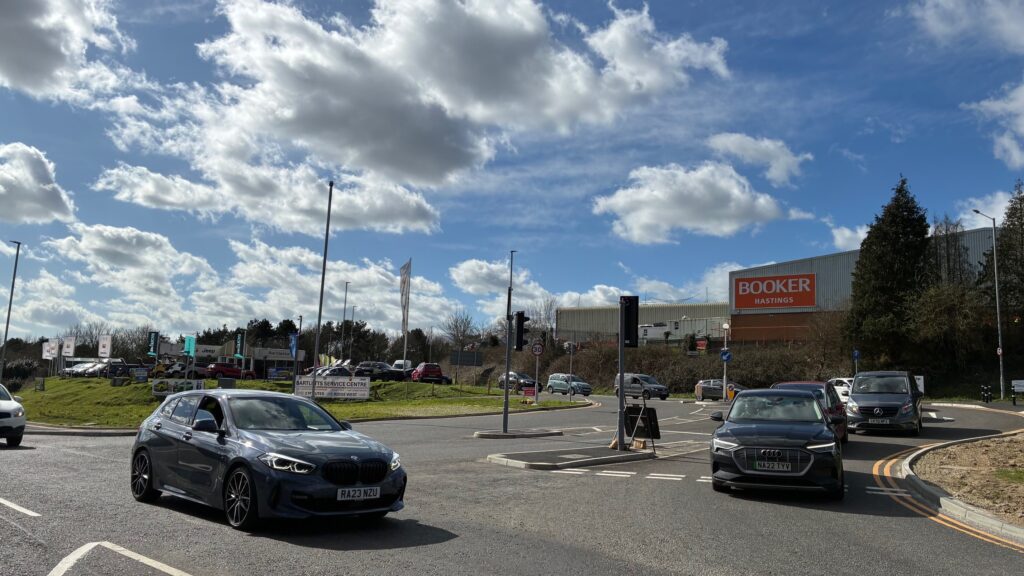
Construction began in 2017, funded through a combination of local resources and additional government funding to help complete the scheme. Most of the road was built by 2019, but the final connection to the A21 remained unfinished for years due to planning and technical issues, including the relocation of a water main and redesigns for junction safety.
When questioned about delays, one East Sussex County Council executive claimed the project was “not our responsibility,” despite the South East Local Enterprise Partnership (SELEP) listing the council as the accountable body for public funds. SELEP later confirmed ESCC’s responsibility and cautioned against deflecting blame.
In March 2024, having secured £2.5 million from central government, East Sussex County Council took sole control of the project and appointed Balfour Beatty Living Places to complete the final works — sidelining Sea Change Sussex, who say they had updated designs ready and offered to licence them to the council at that point. ESCC declined, chose to build to its own specification, and has never publicly explained why. The original plans for a roundabout at the A21 junction were replaced by traffic lights, and costs continued to rise.
Sea Change Sussex has repeatedly sought to shift attention towards the Council, emphasising that it was not involved in the final stage of the road and claiming that safety and design issues were the council’s responsibility. In an open letter to councillors sent in October 2025, the company outlined a long list of technical concerns and asked numerous questions about planning, funding, and statutory compliance, portraying itself as having been sidelined despite earlier involvement in the project. While their claims highlight points of confusion and complexity, they also serve to underscore how poorly managed and opaque the council’s oversight has been, and how accountability for nearly a decade of delays and disruption remains unresolved.
Indeed, by the time East Sussex County Council was required to produce a revised “Light-Touch Business Case Review” in 2024, the project had already moved far beyond its original assumptions. The road was initially expected to open in 2016. Instead, nearly a decade passed before the scheme reached completion. During that time the governance of the project shifted.
Such changes are not minor administrative adjustments. When responsibility moves between organisations during a publicly funded project, it raises fundamental questions about oversight and accountability. Who was responsible for the delays? Who made the key decisions when costs and timelines changed? And why were these issues not subjected to stronger public scrutiny earlier in the process?
The fact that the scheme ultimately required additional government funding to complete only deepens those concerns. The final phase of the project depended on a further £2.5 million of public money to carry out major engineering works, including relocating a significant water main and constructing a signalised junction linking the road to the A21 Sedlescombe Road North — costs that were themselves only part of a wider financial picture that would become clearer once the road was open. When projects evolve to this degree, taxpayers are entitled to clear explanations about why the original plans did not hold.
The scale of those costs has since been confirmed in the council’s own reporting. The Q3 2025/26 Council Monitoring Report, presented to Cabinet on 10 March 2026 by the Chief Executive, recorded a £5.180 million overspend on the programme — driven mainly, the report stated, by the Queensway Gateway Road. The causes identified were redesign requirements, unexpected issues including utility diversions and poor ground conditions, and a decade of construction inflation. This is not an external assessment or a critic’s estimate: it is the council’s own account of what went wrong, set out in a formal report to its own Cabinet. The question of why it took until after completion for this scale of overrun to be set out plainly in a public document is one that deserves a direct answer.
Infrastructure investment can transform local economies. But it also depends on public trust. When a project takes nearly a decade longer than originally expected and requires repeated revisions to funding and governance, residents are left asking a simple question. If this is how major projects are managed, who is actually being held accountable?
Calls for transparency and accountability have largely gone unanswered. Two years ago, Conservative councillors requested a Scrutiny Committee investigation, but this was blocked by their own Cabinet. Members of the public seeking cost breakdowns and explanations at council meetings were repeatedly refused, most recently in September 2025.
Now that the Queensway Gateway Road is open to traffic, it has the potential to deliver on its original promise: improved transport links, reduced congestion, and better access that supports local jobs and future development. Yet for many in Bexhill, Hastings, and Battle, the road has become a symbol of inefficiency, missed deadlines, and unanswered questions. A case study in how major infrastructure can drift off course while public accountability struggles to keep up. Despite repeated delays and major changes to the project’s delivery, meaningful public scrutiny often appeared to arrive only after decisions had already been taken.
The question is not whether the road will eventually provide benefits. The real question is whether the system that delivered it is capable of learning from its mistakes. When major infrastructure projects run dramatically late and require further injections of public money to finish, residents deserve clear answers about how decisions were made and who was responsible when things went wrong.
Local government depends on public trust. That trust is strengthened when councils are transparent about problems and open about how they will improve. But when delays stretch close to a decade and the explanations remain fragmented, it becomes harder for residents to feel confident that lessons have truly been learned.
Questions about oversight, transparency and accountability remain unresolved. Until those questions are addressed openly, this project will continue to stand as a reminder that delivering infrastructure is not just about pouring concrete and laying tarmac. It is about responsible leadership and respect for the public money that makes those projects possible.
Reform UK believes that this situation highlights the deep failings in how East Sussex County Council operates. There has been no openness, no clear leadership, and no accountability for a project that has spent millions and delivered very little for local people.
When democracy is finally restored, Reform UK will push for a full independent review of this project and others like it. We will make sure the truth is brought to light and that the lessons are learned. East Sussex deserves better. Our county deserves competent leadership that delivers results, respects residents, and manages public money responsibly.
East Sussex desperately needs Reform.