Every week, a bin lorry arranged by Rother District Council trundles down your street, lifts your waste, and drives it to a disposal point. At that point, responsibility passes to East Sussex County Council, which arranges for it to be disposed of at a tip or facility, via a contractor it manages, under a policy it sets. Multiple councils. Multiple management structures. Multiple sets of contracts, and multiple bins.
This is not a quirk of Rother. It is how waste works across the whole of East Sussex. Eastbourne, Hastings, Lewes, Rother, Wealden – each district or borough council collects, while East Sussex County Council disposes. It is a system that dates back to the Environmental Protection Act 1990, which formalised the split between Waste Collection Authorities at district level and Waste Disposal Authorities at county level. It made a kind of administrative sense in 1990. In 2026, with councils facing financial crisis and taxpayers demanding value for money, it makes almost none. And the recent rollout of mandatory food waste collections – the most visible new public service to hit East Sussex doorsteps in years – has not only exposed the absurdity of the existing structure. It has added an entirely new layer of environmental and economic questionability that the politicians loudly promoting the scheme seem either not to have noticed, or not to have cared about.
A national problem hiding in plain sight
East Sussex is far from alone in running this split model. Across England, wherever the old two-tier system survives, the same fragmentation plays out: districts collect, counties dispose. The problems this creates are well documented, even if rarely discussed publicly. The Association of Directors of Environment, Economy, Planning and Transport – the professional body representing county and unitary council place directors – has formally called for a fundamental review of the model, arguing that responsibilities should be moved to upper-tier authorities precisely because the split creates inefficiency, inconsistency, and duplication.
The data supports the concern. Research on household waste expenditure shows that disposal costs for upper-tier two-tier arrangements have historically run higher and risen faster than those in unitary areas, where a single authority controls the whole chain. The reason is structural. When the body that collects the waste and the body that disposes of it are different organisations with separate budgets, separate contracts, and separate political masters, perverse incentives emerge. A district council’s recycling rate affects the county’s disposal tonnage and cost, but the district doesn’t carry that financial consequence directly. The county picks up the bill for whatever arrives at the gate – regardless of what decisions the collecting authority made.
Inconsistency at every kerb
Walk from one part of East Sussex to another and you will encounter different collection schedules, different recycling policies, different bin configurations, and different rules about what goes where. Lewes District moved to fortnightly refuse collections in February 2026. Rother operates differently. Eastbourne has its own arrangements. Meanwhile, East Sussex County Council must dispose of whatever comes through the gate, regardless of composition or quality.
This inconsistency is not just irritating for residents. It actively undermines recycling performance and pushes up disposal costs. Contaminated recycling loads – caused by confusion about what can and cannot go in the bin – have a direct financial consequence for the authority footing the disposal bill, yet the responsibility for preventing that contamination sits with a different council entirely. No single authority owns the problem from kerbside to landfill gate.
One small but telling illustration of this dysfunction: East Sussex County Council, as the Waste Disposal Authority, still cannot recycle Tetra-pak cartons – the packaging used for a vast proportion of the food and drink sold in every supermarket in the county. A former county councillor, and Reform UK candidate, with direct experience of the system put it plainly to this paper: if a single authority had responsibility for both collection and disposal and were being judged on a combined recycling rate, making Tetra-pak recyclable would be an obvious priority. Instead, the collecting authorities have no financial incentive to push for it, and the disposing authority has no operational lever to enforce it. The result is that those cartons – millions of them every year across East Sussex – go to incineration. The split system doesn’t just fail to solve problems. It is structurally designed to leave them unsolved.
The same former councillor also makes a point worth noting on the food waste contract specifically: he observes that if Rother District Council were to seek a different disposal arrangement for its food waste – for example, a local anaerobic digestion facility – it would likely require a rewrite of the existing Biffa collection contract, which is structured around the Whitesmith destination. In other words, even if the environmental case for a better arrangement were accepted tomorrow, the contractual architecture makes change expensive and slow. That is the direct consequence of decisions taken without adequate scrutiny at the point when those contracts were signed and extended.
Where unitary authorities have taken over both functions, the results speak for themselves. When County Durham became a unitary council, it rationalised routes, standardised collections, reduced the number of depots, and cut staffing costs by eliminating the artificial boundary between collection and disposal. Those savings ran into hundreds of thousands of pounds annually on collection optimisation alone. Somerset’s pre-unitary waste partnership, where district councils voluntarily agreed to joint collection contracts with a single client unit replacing six separate ones, saved over ~£1.3 million per year – around ten per cent of contractual costs – simply by removing management duplication. East Sussex has never achieved anything comparable.
Follow the lorry: the food waste question nobody is asking
Now add the new mandatory food waste collections – rolled out across Rother, Hastings and Wealden from late March 2026 – and the structural dysfunction becomes not just expensive but actively environmentally questionable.
The arrangement works like this. Biffa, under a seven-year contract worth approximately £119 million shared between Hastings Borough Council, Rother District Council and Wealden District Council, collects food waste weekly from every household. That food waste is then transported to the Woodlands In-Vessel Composting Facility in Whitesmith – a single site, operated by Veolia, sitting beside the A22 in the middle of Wealden district, near Lewes.
Let us be clear about what this means in practice for rural Rother. Whitesmith is around 45 minutes by road from Hurst Green, and approaching 50 minutes from Hastings and parts of the Rother coastline. From the villages and parishes that make up the rural spine of Rother – Northiam, Ticehurst, Bodiam, Salehurst, Ewhurst Green – the drive to Whitesmith is the best part of three quarters of an hour each way. A collection vehicle making stops at low-density housing scattered across the Rother valley and the High Weald, collecting roughly 1.8 kilograms of food scraps per household per week, then making a near-50-minute drive to a composting facility on the other side of the county and the same journey back, is not a picture of environmental progress. It is a picture of a county-wide infrastructure decision made in 2003 being stretched to fit a 2026 reality it was never designed for.
The Whitesmith facility is not a new initiative. It was built as part of East Sussex County Council’s Private Finance Initiative contract with Veolia South Downs Ltd – signed in 2003, extended in 2007, and running until 2033. That single contract, worth £1.1 billion in total and costing ESCC approximately £26 million per year, locked in the county’s entire disposal infrastructure for three decades. The Woodlands composting facility, the Newhaven Energy Recovery Facility incinerator, the Hollingdean Materials Recovery Facility, the waste transfer stations at Pebsham and elsewhere: all Veolia, all PFI, all immovable until 2033.
When East Sussex County Council’s planning committee considered an application from Veolia in November 2025 to extend operating hours and increase throughput at Whitesmith – specifically to handle the additional food waste volumes arriving from the new mandatory collections – Chiddingly Parish Council objected on grounds of noise and highway safety. Councillors approved it anyway. The residents of Chiddingly and the surrounding villages now bear increased heavy goods vehicle movements along the A22 so that households in Northiam and Ticehurst can have their food scraps collected weekly, loaded onto a vehicle that then makes a 45-to-50-minute run to the facility and back.
What makes this picture even more revealing is what happens once that food waste actually reaches its destination. Food waste collected from across Rother is processed at Veolia’s Whitesmith facility — the very same site that Wealden District Council uses for its brown bin garden waste collections. In other words, food waste from Rother households and garden waste from Wealden residents end up in the same composting facility, and are being tipped on top of each other.
That raises an obvious question that nobody in local government appears to have asked out loud: if both waste streams go to the same place, and food waste collection vehicles are already making the journey, why is Rother not offering residents a combined weekly collection of both food waste and garden waste at the same time?
Rother District Council currently charges residents up to £83 a year for a fortnightly garden waste collection, which is then taken to Veolia’s composting facility at Isfield. Both streams end up composted. The logistics are already there. The joined-up thinking apparently is not.
The contrast with West Sussex: a question of ambition
West Sussex, facing exactly the same national mandate, made a fundamentally different infrastructure choice. Food waste collected across West Sussex goes to an anaerobic digestion plant in Horsham – a local facility that converts organic waste into biofertiliser for nearby farmers and generates renewable energy, with surplus electricity exported to the national grid. Short transport distances. Local energy production. The circular economy in a meaningful sense rather than a marketing phrase.
East Sussex has a single in-vessel composting facility on the western edge of the county, baked into a 2003 PFI, serving every district including its most geographically remote rural areas. The facility produces a soil conditioner sold under the brand name Pro-Grow – a reasonable output, but one that generates no energy and that requires far longer transport distances for significant parts of the county.
Before going further, one mitigating fact deserves acknowledgement. The cabinet decision documents show that from June 2026, the new Biffa collection fleet is to run on hydrotreated vegetable oil – HVO fuel – rather than conventional diesel, which the councils say reduces carbon emissions from the vehicles by up to 90%, along with reductions in nitrous oxide and particulates. If that commitment is delivered and maintained, it substantially improves the carbon position of the collection legs.
But HVO fuel does not change the fundamental question of whether Whitesmith is the right disposal destination for food waste collected from the Rother valley. It does not address the missed opportunity represented by the anaerobic digestion model – local energy generation, local biofertiliser, genuinely shorter supply chains – that West Sussex secured and East Sussex apparently never seriously pursued.
The questions that should have been asked – and appear not to have been – are these. When the mandatory food waste collections were being planned, was any assessment published of the transport and environmental cost of routing all collections from rural Rother – up to 50 minutes’ drive from Whitesmith – to a single facility on the other side of the county? Was any case made for an anaerobic digestion facility in the east of the county, closer to the population centres of Bexhill, Hastings and rural Rother? Was the Biffa contract put out to tender with any requirement to minimise disposal distances or incentivise local processing? Has the Joint Waste and Recycling Committee published any scrutiny of the disposal logistics or comparative environmental impact of this arrangement?
The answers to all four questions, as far as the public record shows, appear to be no. We invite the councils concerned to correct us if we are wrong.
The Councillors on the press releases
Three sets of press releases and resident communications were issued between late 2025 and early 2026 to promote the new food waste service. Rother, Hastings and Wealden each published their own versions, and together issued a joint statement in March 2026. The politicians whose names appear on them deserve scrutiny.
From Rother District Council’s own press release of March 2026, Councillor Hazel Timpe – portfolio holder for neighbourhood services, tourism and waste, and a member of the Rother Association of Independent Councillors representing Bexhill Sackville – declared that the new service was “a very positive move. It will reduce the amount of waste that is incinerated and help to protect our environment.” Rother’s council website told residents separately that food waste collections would “reduce our impact on the environment and therefore help towards tackling climate change.”
From the same joint statement, Councillor Jo Walker – lead councillor for environment and neighbourhood wellbeing at Hastings Borough Council, Labour, and chair of the East Sussex Joint Waste Partnership – said the food waste would be processed at Veolia’s composting facility and turned into soil conditioner for local farmers. And Councillor James Partridge – leader of Wealden District Council and the Liberal Democrat half of the Green-Lib Dem Alliance for Wealden coalition – issued this statement, reproduced in full as it appears on Rother District Council’s own press release of 17 March 2026:
“This is a good thing that will help us reduce the amount of waste in our household bins. By separating food waste, we can reduce the amount of waste which is incinerated and make a real difference to the environment.”
These are the faces of this scheme. Their names are on the press releases. Their logos are on the collection caddies delivered to doorsteps across three districts.
And Rother District Council went further still. In late 2025, the Joint Waste Partnership launched a competition for primary school children across all three districts to name the new fleet of food waste trucks. Councillor Timpe said she was “delighted” schools were participating, noting that “young people know how important it is to cut down on the amount of food we all throw away.” Councillor Partridge described “a huge amount of funny, entertaining and joyous names submitted from local schools.” Councillor Walker said she was glad the competition was getting the message out “across all ages.” The winning name – chosen by public vote – was William the Composter.
William the Composter. A cheerfully named food waste vehicle working its rural Rother route, collecting caddy loads from Northiam to Hurst Green, then making a 45-minute drive to Whitesmith and the same journey back. The primary school children who named him were not told that part.
Where are the Greens – and what were they actually responsible for?
Here is where the political accountability becomes particularly pointed. The Wealden Green Party, in coalition with the Liberal Democrats, runs Wealden District Council. Their joint administration – the Alliance for Wealden, formed after the 2023 elections ended 50 years of near-continuous Conservative control – holds the waste collection portfolio. The Greens have 11 councillors and the Liberal Democrats 13. The cabinet includes a Green portfolio holder for planning and environment, and a Liberal Democrat portfolio holder for waste and customer services. The Green Party’s own website states that as part of the Wealden administration, they are responsible for “planning, waste collection, tourism and business support.”
And yet: in October 2024, the extension of the Biffa waste collection contract – the £119 million, seven-year deal that locks in the Whitesmith disposal arrangement until 2033 – was approved at a Wealden District full council meeting held in confidential session, with no public debate. Councillor Stephen Shing, leader of the Wealden Independent Democrats, publicly criticised this decision at the time, telling the Sussex Express that he was “very disappointed the council did not allow the debate to be held in a public meeting section.” He described the contract as covering decisions that “will affect every resident in our district” and that warranted open scrutiny.
The Alliance for Wealden – Green and Lib Dem jointly in power – chose otherwise. A decision with multi-decade consequences for how food waste from villages across Wealden and its partner districts is collected and disposed of was taken behind closed doors. The Green Party, whose founding political purpose is environmental stewardship, was in the room and voted for it. They have not, as far as the public record shows, published any assessment of whether the Whitesmith disposal arrangement represents the most environmentally sound option available, nor any comparison with the anaerobic digestion model used across the county boundary in West Sussex.
The Wealden Green Party’s own website declares that the party believes in “recycling as much waste locally as possible.” Whitesmith is 45 minutes’ drive from Northiam and approaching 50 minutes from Hastings. Whether that constitutes “local” is a question the Greens in administration were ideally positioned to ask. There is no public evidence that they did.
The Green Party also holds five seats on East Sussex County Council – the authority that holds the Veolia PFI and determines where collected waste ultimately goes. ESCC Greens have been vocal on highways policy, on the financial crisis, and on devolution. Whether they have raised, in committee, the question of whether Whitesmith is the appropriate long-term disposal destination for food waste from rural eastern East Sussex is not visible in the public record. If they have, and the minutes show it, that matters and should be acknowledged. If they have not, it is a significant omission for a party that claims environmental leadership.
A direct question to the Liberal Democrats
Councillor Partridge’s quote – “this is a good thing” – requires no political courage and involves no environmental scrutiny. It describes the direction of travel, not the route taken. Diverting food waste from incineration is good. Whether doing so by driving it 25 miles across the county in lorries – rather than processing it locally in an anaerobic digestion facility that would generate energy and biofertiliser within the community – is also good, is a different and harder question.
The Liberal Democrats hold the waste and customer services portfolio at Wealden District Council. They are in government at district level, jointly with the Greens. The Lib Dem leader’s name is on the contract extension announcement and on the food waste launch communications. The question for the Liberal Democrats is the same as for the Greens: did anyone in the Alliance for Wealden administration assess whether Whitesmith is the right disposal destination? Did anyone compare it with the West Sussex model? Did anyone ask whether the contract extension should have been debated in public session before being signed?
The Liberal Democrats campaign on accountability, on local decision-making, and on holding power to scrutiny. In Wealden, on waste, they are the power. Accountability belongs to those who make decisions.
The Conservatives: presiding over the architecture of failure
East Sussex County Council has been under Conservative control for most of the past three decades, and it is the county council – as Waste Disposal Authority – that holds the Veolia PFI and determines where collected waste goes. The Conservatives signed that contract in 2003. They extended it in 2007. They approved the planning application to expand Whitesmith’s capacity and operating hours in November 2025, in a planning committee they continue to control.
The Conservatives’ own published environmental commitments include working to “reduce food waste” and promoting lower-emission fleet operations. What their record shows is three decades of infrastructure lock-in to a single, geographically inconvenient disposal model, with no published assessment of whether alternatives would better serve the county’s rural east. The Conservative group at ESCC has been entirely silent on whether the Whitesmith arrangement is the right long-term answer for villages like Northiam and Hurst Green. They own this arrangement as much as anyone.
Labour: chairing the Partnership, avoiding the question
Councillor Jo Walker of Hastings Labour chairs the East Sussex Joint Waste Partnership – the body that manages the Biffa contract and oversees the operational relationship between the three collecting authorities. Her name is on every joint press release. She is the most visible public face of the food waste rollout.
The Partnership she chairs has not, as far as the public record shows, published any analysis of whether Whitesmith is appropriate for rural Rother households or for Hastings – nearly 50 minutes’ drive away – or whether the AD model in West Sussex should have been explored for the east of the county. Chairing a partnership that manages a £119 million contract carries real responsibility. Welcoming the service as positive for the environment, while the lorries make their 45-to-50-minute runs from the Rother valley and the Hastings coast, is not the same as exercising that responsibility.
The independents: absent from the conversation
In Rother, independent councillors hold significant representation on the district council. Some of the most prominent voices in Rother local politics – the independent and associated councillors who swept Bexhill in 2019 on a platform of community service over party politics – sit on this council, including the portfolio holder for waste itself.
Their collective silence on the food waste logistics question is conspicuous. No independent councillor in Rother appears to have asked publicly where the food waste from Northiam or Hurst Green actually goes, how far it travels, whether the disposal arrangement was ever compared with alternatives, or whether the contract extension decision should have been made in open session. The Bexhill-based independent councillors, not being members of the Joint Waste and Recycling Committee or the cabinet that oversees the disposal contract, may not have been in the room when these decisions were made. But not being in the room is not the same as not asking the question in public – and asking questions in public is precisely what independent councillors, free from party whips and coalition obligations, are uniquely positioned to do. That opportunity has not been taken.
The contract time-bomb: 2033
There is one further dimension to this story that has attracted no public attention at all, and should.
Both the Biffa collection contract covering Rother, Hastings and Wealden, and the Veolia PFI covering disposal for the whole of East Sussex, are scheduled to expire in 2033. The new East Sussex unitary authority is due to take over from the current councils in April 2028 – five years before either contract expires. The unitary authority will inherit both contracts mid-term, with no ability to renegotiate as a single integrated authority until 2033.
Remarkably, the council’s own cabinet decision document acknowledges this sequencing directly, noting that one rationale for extending the Biffa contract to 2033 was “the potential to align the Waste Collection Contract, under the Joint Waste Partnership, with the Waste Disposal Contract, under East Sussex County Council, expiring in 2033.” So the alignment was deliberate. Whether it was designed to facilitate genuine integration at 2033, or simply to defer the hard structural questions by another seven years while current councillors remain in office, is a matter the incoming county council must address.
Done properly, a single East Sussex unitary authority could integrate waste collection and disposal under one management structure for the first time since 1990. A single authority contracting a single fleet, planning disposal logistics based on geography and environmental evidence rather than administrative inheritance – this is more efficient, more transparent, and more defensible on environmental grounds than what currently exists.
But it will also require an honest reckoning with infrastructure. The Whitesmith composting facility will belong to ESCC and Brighton & Hove City Council when the PFI expires in 2033. That is a significant public asset. It is also an asset on the wrong side of the county for the rural eastern districts whose food waste it now processes. The unitary authority must commission a serious assessment of whether the east of East Sussex needs additional or alternative organic waste processing capacity – including anaerobic digestion – and begin that planning well before 2033, not after the contracts have been renewed on existing terms once more.
The questions that demand answers
For the new county council, whatever its political composition after 7 May:
Has any published carbon or environmental impact assessment been carried out on the transport logistics of routing Rother’s food waste – and Hastings’ food waste, nearly 50 minutes’ drive from Whitesmith – to a single facility on the western edge of the county, including a comparison with the anaerobic digestion model used in West Sussex? If not, why not, and when will one be commissioned?
Was an anaerobic digestion facility in the eastern part of East Sussex – closer to Bexhill, Hastings, and rural Rother – considered as an alternative during the food waste planning process? If so, where are the findings? If not, why not?
What are the break clause and renegotiation provisions in the £119 million Biffa contract, and have they been assessed in the context of the 2028 unitary transition?
Does the Veolia PFI contain provisions allowing the new unitary authority to restructure disposal arrangements before 2033?
For the Green Party at East Sussex County Council:
ESCC, as Waste Disposal Authority, controls the Veolia PFI and determines where collected waste goes. Have Green county councillors raised in committee whether Whitesmith is the appropriate long-term disposal destination for food waste from rural Rother and eastern East Sussex? If so, what was the response and where is it recorded?
For Rother District Council:
Rother is the most geographically dispersed district in East Sussex, with significant rural populations in the Rother valley and the High Weald up to 45 minutes’ drive from Whitesmith. Has Rother District Council separately assessed the transport cost and environmental implications for its own residents of the current food waste logistics? Has it raised these concerns with the Joint Waste Partnership or with East Sussex County Council?
For the Green Party and the Liberal Democrats:
The Biffa contract extension was approved in confidential session. Was the disposal destination – Whitesmith – discussed as part of that decision? Was any alternative disposal arrangement considered or costed? Is there any published environmental assessment of this arrangement that residents can read?
Councillor Partridge stated the scheme will “make a real difference to the environment.” On what basis? Diversion from incineration is welcome, but the specific arrangement – its logistics, its carbon footprint, its comparison with alternatives – has never been set out publicly. Where is the analysis?
Summary
The distances involved in East Sussex’s waste arrangements deserve scrutiny in their own right. Your green recycling bin is collected and taken to a transfer station, before being transported to the Viridor Materials Recycling Facility in Crayford, outer London — roughly an hour from Hurst Green and closer to two hours from Bexhill. Your black bin general waste travels to the Newhaven Energy Recovery Facility, an incinerator that burns household waste to generate electricity. Newhaven is over an hour’s drive from northern Rother and around an hour from Bexhill and Battle. These are not short journeys. They represent significant ongoing transport costs and carbon emissions baked into a waste system that was designed around large, centralised contracts rather than local efficiency. When residents are asked to separate their waste carefully and responsibly, they deserve to know how far it is actually travelling — and whether a smarter, more local approach might serve both communities and the environment better.
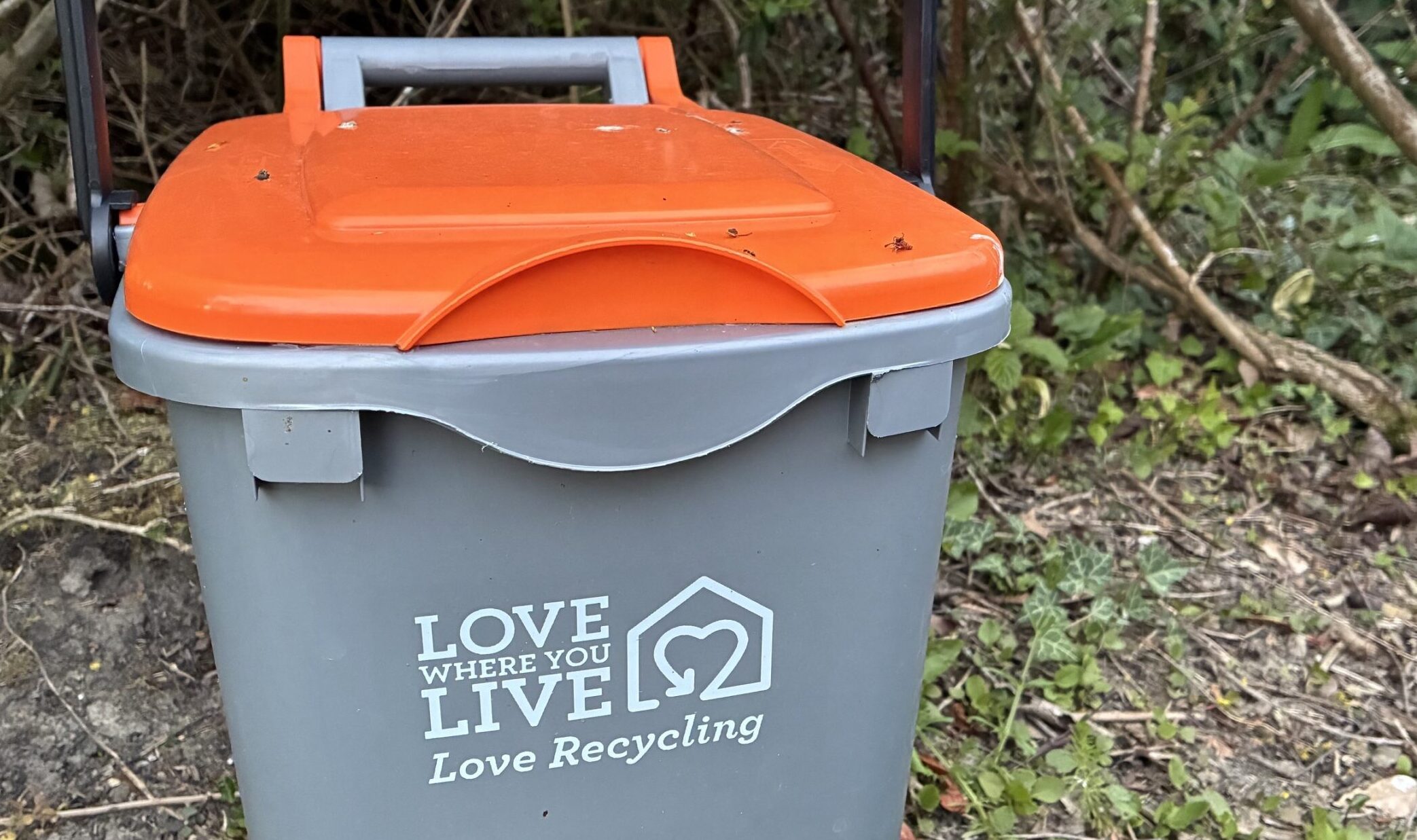
There is one final detail worth adding – one that brings all the grand talk of environmental progress back down to the level of a kitchen caddy sitting uncollected outside the gate of a house in Northiam.
More than a month into the new food waste scheme in Rother, a significant number of residents in rural properties across the district have yet to see a single collection. The orange-lidded caddies were delivered, the letters arrived, residents dutifully began separating their food waste – and then nothing came. When residents have tried to raise the matter with Rother District Council, they have encountered a phone system that, on busy days, simply plays a message explaining that it cannot take any more calls and cuts off. Those who do get through after waits reported at up to 45 minutes have been met with customer service advisors who – understandably – sound exhausted. One resident who spoke to this paper described a call handler who sighed before explaining, with the weariness of someone who had clearly said the same thing many times that day, that the new contractors were having problems finding their way around rural Rother, that the residents should bear with them, and that the call was one of hundreds she had taken about the food waste service since it launched.
Hundreds of calls. A phone system that hangs up on residents. Collection crews who appear not to know the rural road network of the district they are contracted to serve. And a councillor portfolio holder on record saying the new service will “help to protect our environment.”
Perhaps before the next press release is issued, someone might check whether William the Composter has actually found areas such as Northiam yet.
The question of whether any of this was properly thought through – and who is accountable if it wasn’t – deserves a serious answer from every party standing in May, and every party currently in power. Reform UK is committed to scrutinising how public money is spent and how environmental commitments translate into practice across East Sussex. We have written to Rother District Council, Wealden District Council, Hastings Borough Council, East Sussex County Council, and the East Sussex Joint Waste Partnership seeking comment. We welcome on-the-record responses from all parties and organisations named in this article.