The Labour Government’s U-turn on local elections represents more than just a political embarrassment – it’s a victory for democratic accountability that East Sussex voters have been denied for far too long.
In yet another climbdown, Labour reversed its decision to cancel May’s local elections across 30 council areas in England – including East Sussex County Council. The about-face, coming just days before a High Court challenge brought by Reform UK was due to be heard, marks the second time in as many years that our county council elections have been thrown into chaos by Westminster’s reorganisation plans.
For residents across East Sussex, this represents a rare piece of good news in what has been a troubling saga of democratic postponement. After being told in 2024 that May 2025 elections would be postponed, then in September 2025 that no elections were expected until 2027, and then that the May 2026 elections would be formally cancelled, voters have now, finally, had their say on who represents them at county level on 7th May.
But the manner of this reversal, and the broader story it tells about local government in crisis concern us all. The story begins not with Labour, but with the previous Conservative government’s plans for local government reorganisation. East Sussex County Council, along with councils across the country, has been earmarked for fundamental restructuring – the creation of new unitary authorities that would replace the existing two-tier system of county and district councils.
In itself, this is not necessarily objectionable. The principle of streamlining local government to reduce bureaucracy and improve efficiency has merit. But the execution has been chaotic, and the democratic cost is unconscionable.
Last year, Conservative-controlled East Sussex County Council – led by Keith Glazier – wrote to the then-government requesting postponement of the May 2025 elections. The reasoning: why elect councillors to a body that might not exist in its current form within a year or two?
The government agreed, and the 2025 elections were postponed. Following Labour’s landslide general election victory in July 2024, the new government pressed ahead with even more ambitious reorganisation plans. In December 2024, Steve Reed, the new Secretary of State for Housing, Communities and Local Government, invited councils undergoing reorganisation to request further postponements if they had “capacity concerns.”
East Sussex took up the offer. As early as September 2025, ESCC had signalled publicly that it did not expect any elections to be held until 2027 – a remarkable statement that effectively told voters to expect a further two-year wait beyond the original postponement. Conservative councillors argued that managing the complex transition to new unitary authorities while also running elections would stretch resources too thin. Better, they said, to hold just one election in 2027 to the new unitary councils, rather than elect councillors in 2026 who would serve barely a year before those authorities were dissolved.
On January 22nd, the government confirmed that East Sussex was among 29 councils whose May 2026 elections would be delayed. A 30th council, Pendle, was added to the list days later. In total, 4.6 million voters across the country were told they would have to wait another year to cast their ballots. That decision lasted less than a month.
Reform’s Legal Challenge and Labour’s Capitulation
In late January, Reform UK announced it would challenge the election postponements in the High Court, arguing that the government had acted unlawfully and beyond its statutory powers.
The legal challenge was built on serious constitutional grounds. Reform’s lawyers contended that Section 87 of the Local Government Act 2000 – the obscure provision Steve Reed relied upon to delay elections – was designed to adjust election cycles to promote local accountability, not to eliminate elections altogether. They argued that postponing elections during peacetime, absent from extraordinary circumstances like world wars or pandemics, was fundamentally irrational and set a dangerous precedent for democracy.
Perhaps more politically potent was Reform’s framing: that Labour and the Conservatives were “colluding” to deny millions of voters their democratic rights because both parties feared the electoral consequences. It was a narrative tailor-made for Reform’s anti-establishment brand.
The case was scheduled to be heard on February 19th and 20th 2026, but the government blinked first. The announcement effectively represents an unconditional surrender. Not only has Steve Reed withdrawn the postponement decision, but the government has agreed to pay Reform’s legal costs – a tacit admission that their legal position was weak at best.
Democracy Deferred, Democracy Denied
While we can be relieved that May’s elections will now proceed, the fact remains that East Sussex voters have been treated appallingly throughout this process. This will be the second year running that our county council elections have been disrupted by reorganisation plans. Current councillors, elected in May 2021 for a four-year term, have had those terms extended twice now – first by a year, then potentially by two years. Many of them may be dedicated public servants doing their best for residents, but the simple truth is that they have not faced voters since 2021. In that time, we’ve seen a pandemic tail-off, an energy crisis, a cost-of-living crisis, a change of government, and dramatic shifts in the political landscape.
This matters in practical terms. Decisions about devolution, social care funding, transport infrastructure, education services, and the very structure of local democracy itself have been made by councillors who haven’t faced voters for nearly five years. That’s simply too long in a healthy democracy.
The Broader Questions
The election U-turn raises uncomfortable questions that go beyond East Sussex. Why did Steve Reed’s department initially believe it had the legal authority to postpone these elections? The letter to council leaders is telling in its evasiveness – Reed notes that he “wasn’t involved in the initial decision-making” and brought in the Housing Minister to “reconsider the position afresh” in light of “recent legal advice”.
This sounds remarkably like a government trying to distance itself from a decision it now recognises was legally dubious and politically toxic. The speed of the reversal – from defiant postponement to complete capitulation in less than a month – suggests the government’s lawyers took a hard look at Reform’s case and didn’t like what they saw.
There’s also a question of political calculation. Labour currently controls roughly a third of the councils that were due to have elections postponed. While this doesn’t suggest a partisan conspiracy, it does mean the government had no obvious electoral motive for the delays. More likely, this was a combination of administrative convenience and genuine concern about council capacity mixing with insufficient attention to the democratic implications.
But the appearance matters. When a government postpones elections – any elections, for any reason – it invites suspicion about its motives. The fact that both Conservative and Labour politicians supported these delays, feeds into a narrative about establishment parties rigging the system to avoid accountability.
The Way Forward
So where does this leave us? Voters should pay close attention to how candidates address the reorganisation process. The creation of new unitary authorities is still going ahead, with elections to those new bodies expected in May 2027 and the authorities themselves taking over in April 2028. This means that whoever we elect in May will serve for approximately one year before the county council is dissolved.
This is admittedly an awkward situation. Candidates will need to explain what they can realistically achieve in that timeframe, how they’ll ensure a smooth transition to the new unitary system, and what their vision is for local government’s future structure. These are complex questions without easy answers.
But that’s precisely why this election matters. The transition to unitary authorities will shape how we’re governed for decades to come. Decisions about which services move where, how budgets are allocated, and what democratic accountability looks like in the new system need to be made by people with a current electoral mandate.
The government’s announcement of £63 million in additional funding for councils undergoing reorganisation is welcome, though it comes rather late in the day. East Sussex will receive its share of this pot, which should help ease some of the capacity concerns that prompted the postponement request in the first place.
A Victory for Democracy – But Questions Remain
Make no mistake: the U-turn is a victory for democratic accountability and to Reform UK leaders for having the determination and resources to mount a legal challenge. Sometimes it takes an outsider to defend principles that establishment parties have grown too comfortable compromising.
But this should never have been necessary. A government confident in its democratic legitimacy doesn’t try to postpone elections affecting millions of voters. A political system working properly doesn’t require court challenges to ensure people can exercise their fundamental right to vote.
On the 7th May, East Sussex voters used this hard-won opportunity. They asked candidates tough questions about reorganisation, about service delivery, and about how they’ll protect residents’ interests during a tumultuous transition. Residents held candidates accountable for the fact that some of their colleagues sought to avoid this reckoning altogether.
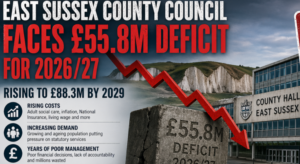
The stakes were higher than a routine council election. East Sussex County Council is in financial crisis after fourteen years of Conservative control. The council borrowed £70 million from central government just to balance its budget – borrowing that carries £3 to £3.5 million a year in interest charges alone, money that cannot be spent on roads, libraries or care. Council tax has been raised to the legal maximum of 5%, and the council has already made £156 million of savings since 2010. It is still not enough. The council’s own warnings indicate it may need to apply for emergency financial supervision from Westminster – in plain terms, the money is running out. Three quarters of the usable budget is now consumed by just two services: adult social care and children’s services. Everything else must come from what remains.
Neither party in Westminster has served East Sussex well. The Conservatives shelved Andrew Dilnot’s fully costed social care reform plan in 2011 and never returned to it across four prime ministers and fourteen years. Labour’s new funding formula cuts East Sussex’s allocation by £12.6 million, removes rurality as a factor, and ignores the exceptional proportion of older residents in the county. Both parties have treated East Sussex as an afterthought.
And there is a longer game in play. Those elected will serve for between one and two years before the county council is dissolved into new unitary authorities. That makes this election more consequential than its short timescale suggests. The people that were elected in May will shape how that transition happens – which services go where, how budgets are allocated, what local democracy looks like for decades to come. The question voters should be asking is a simple one: do you trust the people who created this crisis to design its replacement?
And perhaps most importantly, remember this moment when politicians claim that postponing democracy is never in voters’ best interests. This event proves that when the people push back, even governments in Westminster must listen.
The ballot box is the foundation of our democracy. It should never be taken away lightly, and it should never require a court case to get it back.