
Anyone who has walked Bexhill’s seafront in summer will remember the fountains near the De La Warr Pavilion with fondness. Over the Summer, those jets of water brought laughter and life to the promenade. Thousands of children splashed, tourists paused for photos and for a moment the seafront felt iconic, a place that valued community and beauty. But since 2019 those fountains have stood silent, a sad emblem of bureaucracy, poor planning and a District Council that has lost its way.
The fountains were originally installed in 2011 as part of a broader seafront regeneration linked to improvements around the Pavilion and Colonnade. Its promise of civic pride was quickly undermined. By 2017 the problems were clear, and in the last few years before its permanent closure, the fountains suffered an increasing number of faults, operating only intermittently and often delayed while the water tank refilled from the mains. All equipment, including the fountain’s clean and dirty water tanks, the pumps and the pipework connecting mains water to the tanks and fountain jets, was installed underground, a design choice later deemed by District Council commissioned surveys that made maintenance unnecessarily complex and risky.
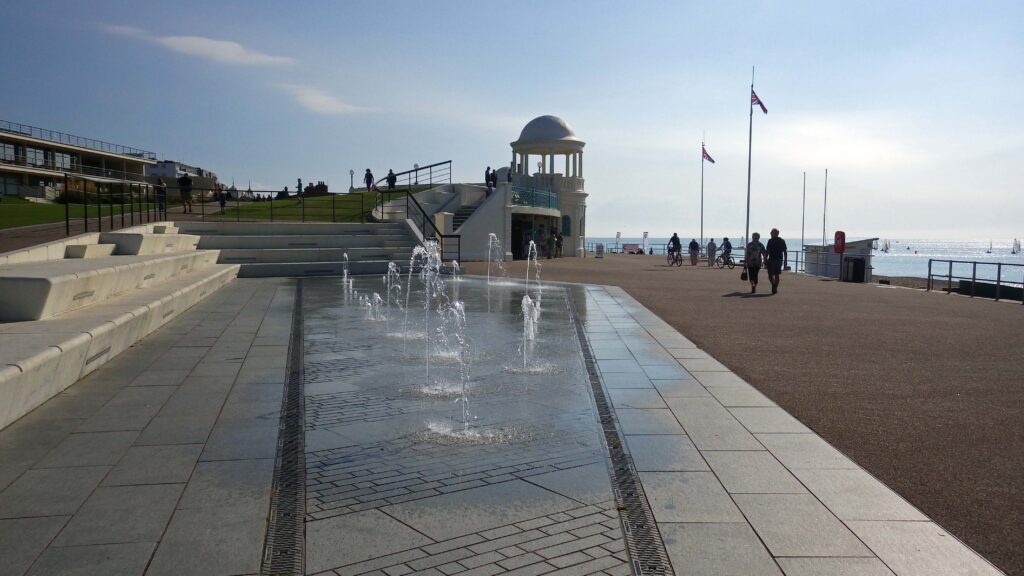
By 2018, structural and mechanical surveys confirmed the inevitable. The whole system was leaking water, the tanks were likely compromised and at risk of collapse, and underground pipework was suspected of additional leaks. Surveys also revealed that the wrong type of plastic had been used in key components confirming the full extent of the problem would require excavating the subterranean plantroom, a major and costly operation.
Meanwhile, the leaking system carried a surprising financial toll: £10,000 in mains water and sewerage bills between April 2018 and June 2019 alone, most of it likely leaking into the ground. Despite this, there appears to have been no attempt to reach an agreement with South East Water to reduce these costs. Public records also show considerable Council staff time was also consumed managing frequent complaints and enquiries from frustrated residents.
In spring 2019, the council decided to close the fountains altogether due to the risk posed to officers entering the underground plantroom to maintain pumps and test water quality. The risk to the public above ground was minimal, but for staff, the threat of structural collapse was real. A report to the District Council highlighted that the only way to remedy the situation would involve excavating the majority of the site, removing and reinstalling the 32 pumps, replacing the water tank, and repairing all underground pipes – a daunting and expensive task.
The council’s explanation for the closure was that technical challenges were considerable and the cost soared. Repairs initially estimated around £350,000 had ballooned to near £1 million. Officers advised the District Councilors that without excavating the entire area, diagnosing and fixing the leaks and replacing the tank and pipework, the fountain could not be reliably restored. The decision was framed as responsible, balancing public amenity with fiscal caution.
Residents who remember how magical those fountains could be will not find comfort in these justifications. What they see is a patchwork approach, a project launched without proper foresight or long-term guidance. The involvement of multiple contractors, each seemingly able to avoid responsibility, points to weak oversight at the outset. Indeed, if inferior materials were specified for use in a marine environment where salt, wind and frost are constant threats, then the failure began long before the first leak appeared.
We believe there was a better way
Reform UK believes that councils should be custodians of place and prudent stewards of public funds. In this case those responsibilities have clashed to the detriment of both. Instead of finding a workable solution, the fountains have lingered in limbo, a drain on civic pride and a visible reminder of unfulfilled potential.
If entrusted with local leadership, Reform UK would have approached this challenge with a clearer clarity of purpose and stronger professional rigour. Rather than accepting an underground tank as a default, we would have questioned its necessity from the outset. In a seaside town where the sea is our most natural asset, why not draw from it directly? Was using precious mains water really necessary? A fountain or splash feature that used seawater, appropriately filtered and circulated, could have reduced the need for a buried reservoir and minimise complex pipework, making the feature to be simpler, cheaper to maintain and iconic in its own right. Indeed was the whole fountain design overly complex?
If the aim was to create a space families love and visitors talk about, then the design need not have mimicked fountains seen elsewhere. We would have explored alternatives such as an outdoor paddling pool with integrated fountains in the adjacent grassy area or even on the beach. Such a facility could have served a dual purpose: a safe play space for children and a more flexible water feature that adapts to tides and seasons, with simpler mechanical demands. Proper consultation with civil engineers and coastal specialists at the design stage could have spared years of disappointment and expense.
Instead, the District Council commissioned an architecturally ambitious, but difficult design, obscured the issue when problems arose and now faces a substantial bill at taxpayers’ expense. The opportunity cost is more than financial. It is the cost of the then Conservative led, District Councillors ‘theme park ambition which might have delivered had they been matched with sound engineering and common sense.
Our town deserves better. We support revitalising our seafront not only with heritage conservation but through projects that combine engineering excellence, social value and aesthetic appeal. The fountains could have been a joyful expression of Bexhill’s identity. Instead they have become a symbol of stalled ambition.
For decades, there has been a glaring absence of imaginative placemaking around the Seafront. The De La Warr Pavilion itself, an architectural gem dating from 1935 and an anchor of the town’s cultural life, continues to celebrate international art and community engagement. Yet just beyond its doors, the public realm feels neglected.
Reform UK urge Rother District Council and its partners to think bigger and smarter. Engage with independent design professionals early, make better use of natural assets like the sea and, above all, listen to the residents who want functional, attractive, affordable public spaces that work.
The fountains could again be a source of pride. What’s needed is leadership that chooses bold solutions over bureaucratic paralysis, and vision over excuses.
The financial waste is undeniable. £10,000 in water and sewerage charges over just 14 months for a feature that barely functioned should concern every taxpayer. Add to that the officer time spent handling complaints, testing pumps, and attempting to maintain a system fundamentally flawed by design, and it becomes clear that long-term efficiency or accountability were not prioritised.
Beyond cost, the project exposes a lack of ambition. With imagination and sound planning, the fountains could have been a defining feature of Bexhill, complementing the Pavilion’s cultural draw and strengthening tourism. Instead, residents are left with a dormant water feature and a missed opportunity.
Reform UK would not have accepted excuses for a feature that fails the public. Civic pride is built on delivery, not on deferred maintenance and technical workaroundsPoor planning, hidden costs, and an overly complicated design have turned a potentially iconic seafront feature into a cautionary tale.
There is, however, reason for cautious optimism as Rother District Council has finally acknowledged the need for independent external expertise.In November 2025, the council issued a pre-market engagement notice, inviting industry and engineering experts to propose robust, long-term solutions.
The fountains could still splash again, if only the lessons of the past are finally learned.